If you’ve ever stared at the cover of Nostalgia, Ultra and felt an inexplicable urge to own a boxy little BMW from the 1980s, you’re not alone. That bright orange coupe has done more for the reputation of the BMW E30 M3 among a generation of music fans than any car magazine ever could. So it’s no surprise that one of the most persistent questions people type into Google about the notoriously private singer is a simple one: what car does Frank Ocean drive?
The short answer is that Frank Ocean is a lifelong BMW obsessive whose signature ride is the orange BMW E30 M3 the same model immortalized on his 2011 mixtape cover. But the fuller answer is far more interesting, because the car on that cover was never actually his, and the story of how he eventually got his own is a small legend in car culture. Below, we’ll break down the orange E30 M3 myth, the real machine Frank had built for himself, and the surprisingly deep garage he’s assembled over the years from crashed Acuras to a McLaren 675LT.
Frank Ocean is best known for driving an orange BMW E30 M3, but he doesn’t have a single “daily driver” that defines him. He’s a serious car enthusiast with a rotating collection that has included multiple generations of the BMW M3 (E30, E46, E90/E92), an F10 M5, a BMW X6, a McLaren 675LT, a Porsche 911 GT3, and a Tesla Model X, among others. Cars are woven so deeply into his music and visuals that they’ve become part of his artistic identity not just transportation.
Now let’s get into the details, starting with the car everyone associates with him.
The Orange BMW E30 M3: The Most Famous Car He Never Owned
Here’s the myth-buster that surprises most fans: the iconic orange E30 M3 splashed across the cover of Nostalgia, Ultra was not Frank Ocean’s car. It wasn’t even his photograph.
The image was originally posted around 2009 on a BMW enthusiast forum (the S14/bimmerforums community) by a member who went by the username Dricebug. He had photographed a modified 1988 BMW E30 M3 in Hockessin, Delaware, and shared the shots the way any proud owner shares their build. According to the enthusiast who took it, Frank never reached out for permission before using the photo as his mixtape cover, and later attempts to get in touch reportedly went nowhere definitive.
So how did a random forum photo become one of the most recognizable album covers of the 2010s? By most accounts, Frank stumbled onto the picture while he was finalizing the project and chose it because the E30 M3 was his dream car and the sun-baked orange coupe perfectly matched the mixtape’s themes nostalgia, summer, memory, the ache of looking backward. It’s a fitting origin, honestly. A tape called Nostalgia, Ultra, defined by a borrowed image of a car the artist longed for but didn’t own, is almost too on-the-nose. The longing was the point.
The original car photographed for that cover reportedly changed hands within the forum community and was sold to another member for a modest sum the kind of money you could imagine a clean, well-loved E30 going for before these cars became six-figure collector items. Frank never ended up buying that specific vehicle. (Details like the exact sale price and buyer circulate as forum lore, so treat the precise figures as enthusiast-community legend rather than confirmed record.)
Frank Finally Built His Own Orange E30 M3
The best part of the story comes years later. After the success of Nostalgia, Ultra and Channel Orange, Frank had both the means and the motivation to stop dreaming about the car and simply own it. So he had his own orange E30 M3 built to mirror the cover car a real, running homage to the image that helped launch his career.
The tell-tale detail that separates Frank’s personal build from the original cover car is subtle: the mirror caps. On Frank’s car, the mirrors are painted orange to match the body, while the car in the original cover photo wore black mirrors. It’s the kind of small spec choice only a true enthusiast would notice and only a true enthusiast would bother to change. Car-culture accounts credit specialist shops in his orbit (the same builders who helped prepare his fleet of tour cars) with bringing the tribute car to life.
That’s the poetic full circle: the man built the fantasy he’d once borrowed a photo of.
What Even Is a BMW E30 M3, and Why Do People Lose Their Minds Over It?
For readers who came for Frank and stayed for the cars, a little context explains why the E30 M3 carries so much weight.
The E30-generation M3 was produced from roughly 1986 to 1991 and was, in essence, a race car with license plates. BMW built it to go touring-car racing (the DTM series in particular), and homologation rules meant they had to sell a road-going version to the public. The result was a compact, boxy, flared-fender coupe powered by a high-revving four-cylinder engine making somewhere in the region of 200 to 238 horsepower depending on the version, paired with a five-speed manual. On paper those numbers sound modest today. In reality, the E30 M3 is one of the most celebrated driver’s cars ever made light, balanced, mechanical, and utterly analog in an era when cars keep getting heavier and more digital.
That analog purity is a big part of why the E30 M3 resonates with artists like Frank Ocean and his longtime collaborator Tyler, The Creator, who famously drives his own repainted E30. The car is nostalgic by nature. It’s a machine from a simpler time that you have to actually drive, and that emotional register lines up perfectly with the music both artists make.
Frank Ocean’s Broader BMW Obsession
The orange E30 M3 might be the headline, but it’s only the beginning. Frank Ocean may be one of the most dedicated BMW collectors in music, and by some accounts he’s owned well over ten of them across his life.
Once his career took off, the BMWs multiplied quickly. His first car bought with music money was reportedly a BMW 550i a proper luxury sedan and a clear signal of where his tastes were heading. From there, the M cars piled up. Beyond the E30 M3, his BMW history is said to include:
- An E90/E92-generation M3, which he reportedly crashed on one occasion (an occupational hazard for anyone who genuinely uses fast cars rather than garaging them)
- An F10 M5, the twin-turbo super-sedan
- Multiple E30s in various specs and wraps
- An E46 M3, widely regarded as one of the best-driving M3s ever made
- A BMW X6, which he even name-checks in the song “Ivy,” anchoring that lyric to a specific moment around 2010 in his personal timeline
Keeping an accurate count is genuinely difficult, because Frank treats cars less like static trophies and more like props, characters, and set pieces in his visual world.
The 2013 Tour Fleet and Frank’s Movie-Car Moments
The clearest example of Frank turning cars into art came around his 2013 European tour, when he reportedly had a fleet of roughly five BMWs prepared, several of which turned up in his visuals and in the pages of his Boys Don’t Cry magazine. Among the most memorable were an E30 dressed in a giant Nike swoosh livery and an M3 presented inside a life-sized toy-car box, as if it were a scale model just unwrapped from a shelf. A striking golden E30 that appears in his magazine imagery actually belonged to the owner of the specialist shop that helped build his tour cars, rather than to Frank himself.
These weren’t garage-queen supercars posed for clout. They were characters. Frank uses cars the way a director uses a recurring location to set a mood, mark a memory, and tie a song to a specific stretch of his life.
Beyond BMW: The Supercars and Everything Else
While BMW is unquestionably his first love, Frank Ocean’s taste runs wide. His collection and documented interests have stretched into serious exotic and performance territory:
McLaren 675LT A track-focused, limited-run British supercar and one of the most driver-oriented machines McLaren has ever built. It fits Frank’s pattern: he’s drawn to cars that are about the experience of driving, not just the badge.
Porsche 911 GT3 (991) Arguably the purest driver’s Porsche of its era. Frank’s is from the 991 generation (built between roughly 2013 and 2019), a naturally aspirated, high-revving, track-day weapon with a big rear wing and a razor-sharp chassis. He’s been spotted using it on circuits a detail that reinforces that he actually drives these things rather than collecting them for display.
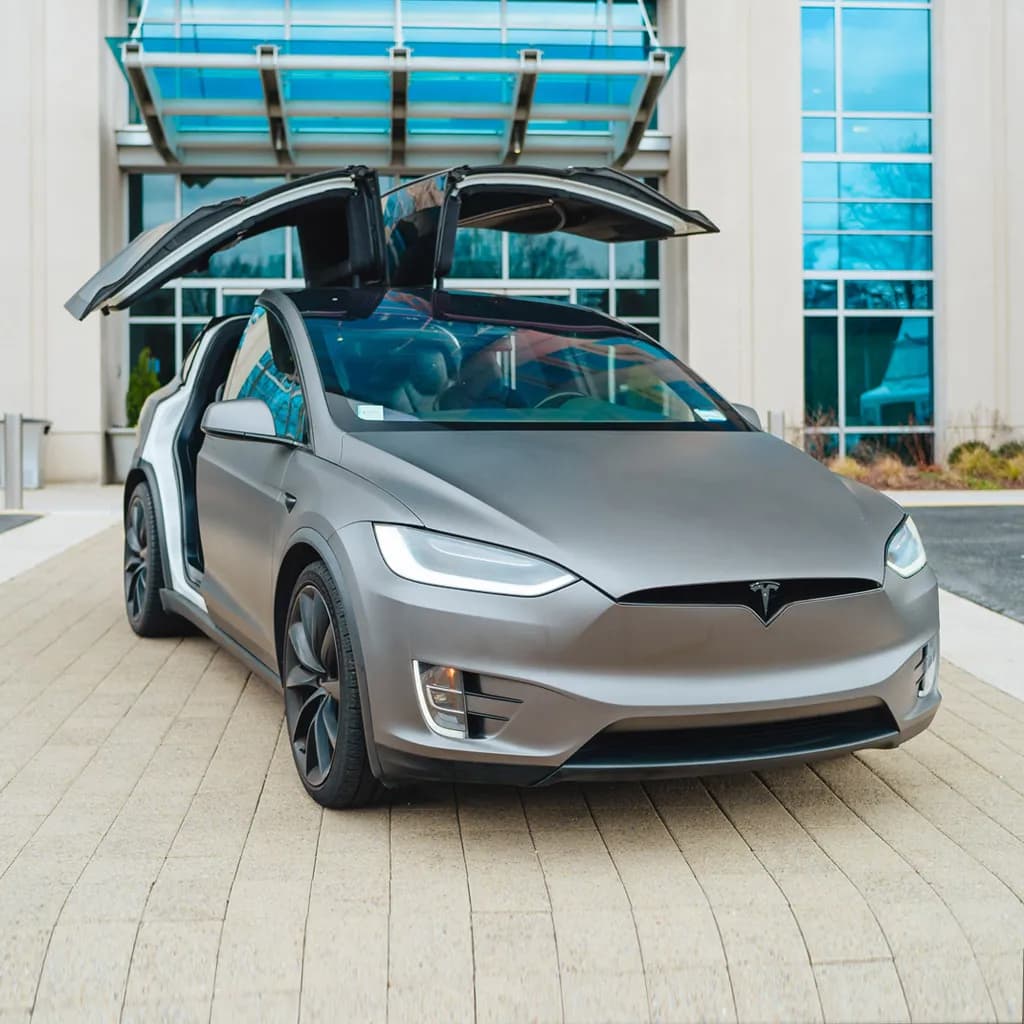
Tesla Model X The practical, electric counterweight to all the analog metal, and proof that his interests aren’t purely retro.
Beyond what he’s owned, Frank has expressed affection for an eclectic mix of European and Japanese machinery: the Nissan Skyline, the wild Mercedes-Benz CLK DTM, the Audi RS4, and the Subaru Impreza, alongside bigger SUVs like the Mercedes G-Wagon, the BMW X6, and the Porsche Cayenne. It’s the taste profile of someone who genuinely loves cars across the spectrum race homologation specials, rally icons, and daily-usable luxury alike.
Part of what makes Frank’s car obsession feel authentic rather than performative is that it clearly predates his money. Like most people, he started at the bottom of the automotive food chain.
His first car was reportedly a stick-shift Acura Integra with tinted windows and a loud exhaust the platonic ideal of a young enthusiast’s first ride. That Integra met a dramatic end: by his own telling, he fell asleep at the wheel and put it into water. He later immortalized the era in his music, and even nodded to the moment with an Acura/Honda NSX (with its signature pop-up headlights) appearing in a night-driving visual.
After the Integra came a 1991 Honda Civic bought for around a thousand dollars, and then a 2002 Nissan Maxima. There’s a great detail from those early years: he reportedly used to drive around listening to his own works-in-progress, checking how the songs sounded through car speakers the ultimate real-world mixing environment. Anyone who’s ever judged a new track by how it hits in the car will recognize that instinct immediately.
Cars in Frank Ocean’s Music: A Recurring Character
You can’t fully answer “what car does Frank Ocean drive?” without acknowledging that cars in his catalog are as much a lyrical device as a lifestyle. They function as vessels for memory, freedom, heartbreak, and escape.
The most obvious example is “White Ferrari” from Blonde a devastating, feather-light ballad about love that arrives too late. Interestingly, there’s no white Ferrari in Frank’s actual collection; the car is pure metaphor, a symbol of a fleeting, beautiful, doomed moment. Fans have long connected the imagery to 1980s Ferrari icons like the white Testarossa made famous by Miami Vice, layering the song with decades of pop-culture association.
Cars turn up everywhere else in his work, too. “Swim Good” features a Lincoln Town Car. “American Wedding” rides on the back of a Mustang. Across Endless, Blonde, and his deep cuts, he references everything from Bugattis to Xenon headlights, each one tethering a verse to a specific feeling or time. Even his branding leans automotive: the stylized Blonde logo is widely noted to be a modified NASCAR-style wordmark, and the album’s alternate cover photography connects to Japan’s Fuji Speedway. For Frank, motorsport iconography isn’t a costume it’s part of the vocabulary.
The BMW Coachella Teaser: Did BMW Almost Team Up With Frank?
In April 2023, right before Frank’s headline Coachella performance, BMW’s official U.S. channels stoked the fandom into a frenzy by posting a short teaser featuring you guessed it an orange E30 M3, the spitting image of the Nostalgia, Ultra cover car. The caption leaned into the mystique, framing it as the past meeting the future and inviting fans to speculate about what might come next, echoing the prophetic tone of his song “Nikes.”
For a fanbase conditioned to read tea leaves after years of Frank’s silence, this was catnip. Was a collaboration coming? A special M car specced by Frank himself? A re-release of the mixtape to streaming? BMW never fully cashed the check on that hype, and as of now it stands as a tantalizing “what if.” But the very fact that BMW’s marketing team reached for the orange E30 M3 to get Frank fans talking tells you everything about how completely that car and that artist have fused in the public imagination.
Why Cars Matter So Much to Frank Ocean
Strip away the spec sheets and the collection lists, and the real answer to “what car does Frank Ocean drive?” is something closer to a philosophy. Cars, for Frank, are emotional technology.
He’s spoken about his car obsession with a kind of self-aware honesty even acknowledging that a collaborator once teased him that the whole fixation was a bit of a cliché. But the obsession clearly runs deeper than status. The car is where he tested his early music. The car is the setting for countless memories his lyrics excavate. The car is a private, moving room one of the few places where you’re alone with a song and the road. That’s why an E30 M3 he didn’t even own could become a defining image of his art, and why he eventually felt compelled to build the real thing. The fantasy mattered enough to make it physical.
So while the internet will keep asking which single car Frank Ocean drives, the truer picture is a garage full of meaning: analog M cars, a track-ready Porsche, a supercar or two, and the ghosts of a crashed Integra and a thousand-dollar Civic that started it all.
Frank Ocean’s Cars: Quick Reference List
For easy scanning, here’s a rundown of the notable vehicles associated with Frank Ocean over the years:
- BMW E30 M3 (orange) his signature car and Nostalgia, Ultra cover model; he later had his own built with orange mirror caps
- BMW E46 M3 a fan-favorite driver’s M3
- BMW E90/E92 M3 reportedly crashed at one point
- BMW F10 M5 twin-turbo super-sedan
- BMW 550i reportedly his first car bought with music money
- BMW X6 referenced in “Ivy”
- Multiple additional E30s including tour and visual cars (Nike swoosh livery, toy-box M3)
- McLaren 675LT limited-run British supercar
- Porsche 911 GT3 (991) track-focused naturally aspirated Porsche
- Tesla Model X his electric daily-usable option
- Acura Integra first car, ended up in the water
- 1991 Honda Civic and 2002 Nissan Maxima early pre-fame cars
Frequently Asked Questions
What car does Frank Ocean drive? Frank Ocean is most associated with the orange BMW E30 M3, the model featured on his Nostalgia, Ultra cover. He doesn’t have one single public daily driver, but he’s a devoted car collector whose garage has spanned multiple BMW M cars, a McLaren 675LT, a Porsche 911 GT3, and more.
Was the orange BMW on the Nostalgia, Ultra cover actually Frank Ocean’s car? No. The cover image was a photo of a modified 1988 E30 M3 taken by a BMW enthusiast and originally posted on a car forum. Frank chose it because the E30 M3 was his dream car and it matched the mixtape’s nostalgic themes. He later had his own orange E30 M3 built as a tribute.
How can you tell Frank’s orange E30 M3 apart from the cover car? The easiest tell is the mirror caps. Frank’s personal build has orange-painted mirrors to match the body, while the original cover car wore black mirrors.
Does Frank Ocean really like BMWs that much? Yes. He’s regarded as one of the most dedicated BMW enthusiasts in music, reportedly owning well over ten BMWs across his life, with the E30 M3 recurring throughout his visuals and lyrics.
Is there a real “White Ferrari” in Frank Ocean’s collection? No. “White Ferrari” from Blonde is a metaphor rather than a reference to a car he owns. The imagery is widely linked to 1980s Ferrari icons in pop culture.
Did BMW ever collaborate with Frank Ocean? BMW USA teased fans with an orange E30 M3 video ahead of his 2023 Coachella set, sparking widespread collaboration speculation, but no official partnership has been confirmed.
Ask what car Frank Ocean drives and the honest answer is: many, but one above all. The orange BMW E30 M3 is more than a vehicle in his story it’s a symbol of longing made real, a borrowed dream he eventually built for himself. Add a garage of M cars, a Porsche GT3, a McLaren, and the humble Hondas and Acuras that came before, and you get the portrait of an artist for whom driving has always been part of the music. For Frank Ocean, the car isn’t just how he gets somewhere. It’s where the feeling lives.